Students, sex, and STIs

You've been out for an evening with your group of friends or student union. It was very cozy, the music was loud and the drinks flowed abundantly. Maybe you even took someone home that night or ended up in bed somewhere else. But do you remember if a condom was used that night? Research by Rutgers and SOA Aids Nederland shows that in practice 4 out of 10 one-night stands among young people and students (younger than 25 years old) do not use a condom. If it's not a one-night stand but a short-term sexual relationship then even in 75% of the cases no condom is used.
Why is the use of condoms so low?
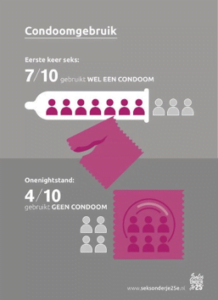
Studenten gaven aan dat seks met een condoom vaak als onprettig ervaren en het merendeel van de jongeren en studenten <
25 jaar gaf aan liever geen condooms op zak te hebben. Het bij je dragen van condooms wordt door vele nog vaak gezien als een taboe. Dit zou dan misschien het beeld kunnen scheppen dat je van te voren al maar uit was op één ding, namelijk SEKS! Een beeld wat men zegt liever te willen voorkomen. Daarnaast worden de risico’s op het oplopen van een soa (seksueel overdraagbare aandoening /geslachtsziekte) onderschat. Dit terwijl, juist vanwege de nieuwe vrijheden van het “op kamers” wonen, het aantal wisselende contacten en dus ook het risico op het oplopen van een soa vele malen hoger ligt in deze levensfase.
Student misconceptions about sexually transmitted diseases (STIs)
We often come across misconceptions about the dangers of contracting an STI. But also the way in which you can or can't catch an STI is still often unclear.
- When I catch an STI, it always causes me physical complaints.
Dat is zeker niet altijd het geval; 90% van de vrouwen heeft geen klachten na het oplopen van een chlamydia infectie. Het kan dus zo zijn dat je een soa hebt, zonder dat je dat weet.
- If it looks clean and fresh underneath, my sex partner doesn't have an STI(s).
This too is not always correct. As already mentioned, an STI does not have to lead to complaints. So you or your sex partner can have an STI without you knowing it.
- The pill protects against contracting STIs
The pill only protects against unwanted pregnancy but does nothing to prevent the contracting of sexually transmitted diseases (STIs). If you want to be well protected against both unwanted pregnancy and STIs, use the pill and a condom (also known as "double dutch").
- I can't get STIs with oral sex.
Bij orale seks (pijpen, beffen, of orale anale seks) kunnen wel degelijk soa’s worden doorgegeven. Bij orale seks ben je het meest kwetsbaar voor het oplopen van Chlamydia, Gonorroe of Syfilis.
- Getting an STI isn't so bad, you'll be out of it in no time.
The treatment for the most common STIs is fairly simple. However, treatment is necessary. Not just so you can't infect anyone else. An STI also has its dangers. Chlamydia (the most common STI in the Netherlands), for example, can make you infertile. The longer you walk around with an STI, the more dangerous it is. Always have yourself tested after unsafe sexual contact!
- Once you've had an STI, you'll never get it again.
This isn't right either. In fact, if you are infected with the herpes virus, for example, you remain a carrier and you can have an outbreak more often. The same goes for genital warts. Chlamydia and Gonorrhoea can also be given to you several times. Treatment may become even more difficult because the virus is becoming increasingly resistant to existing drugs.
Young people often don't use a condom and often don't do an STI test after unsafe sexual contact.
Despite the low condom use, an STI test is unfortunately rarely done. Only 13% of men and 18% of female students have taken an STI test in the last 12 months after having unsafe sex. Even if a condom is used at the beginning of a longer lasting relationship, this use often stops after a while. Before a stop is made, more often than not an STI test is done. A frequently mentioned reason is the growth of mutual trust. The thought is often: "I know my partner a little better now, and he or she has no complaints and/or shows no sexual risk behaviour, so he or she probably hasn't caught an STI...". A large proportion of the students indicate that they have only been tested for the first time after they have heard about the risks of STIs from one of their friends. Talking about STI testing still turns out to be a taboo subject, so there is hardly any talk about it. In addition, students nowadays hear that doing an STI test is something that is done quickly and easily, which means that the risk of using a condom is often regarded as negligible. But why, if one is aware of STI testing and this is seen as simple, is there so little testing in practice?
Different ways to test for STIs; high thresholds, high cost, low reliability
 The most common places where an STI test can be done are the following: the Municipal Health Servicethe family doctor or an STI home test. A test at the GGD is possible, as long as you are younger than 25 years. However, there is a good chance that you will have to wait a long time before you can go to the doctor, or that you will be referred to the doctor after all. In addition, the waiting time for a result is long: about two weeks. Unfortunately, in practice, this still stops students.
An STI test with a general practitioner often turns out to be a (too) high threshold for students. Have you already registered with a new local doctor after moving to your new room? And have you ever been through that before? For many students, this is not the case.
The test at the doctor's is also based on the deductible. In practice, a large number of students opt for (student) health insurance with the option of opting for a higher deductible. This is due to the expectation that you will hardly receive any care with the monthly lower premium in return. This can make the price go up quite a bit. But then, what now?
An STI at home test is then a much heard alternative. However, these STI tests are often not reliable. If you did take a reliable STI home test, and this test shows that you are infected with an STI, what treatment do you get for that STI? A treatment is often not as simple as that and often means that you still have to contact the GGD or general practitioner.
OneDayClinic offers anonymous, fast, affordable, 100% reliable STI testing in Amsterdam, Utrecht, Den Bosch and Rotterdam and surroundings.
The OneDayClinic aims to make it easier for students to perform an STI test safely and anonymously. Are you looking for another option, or do you think it would be wise to get tested? Then simply come to the OneDayClinic and get tested! A visit to the OneDayClinic only offers advantages, especially for students!
- You can be tested completely anonymously today.
- You can ask any of your questions to one of our specialist doctors in advance (telephone, Facebook Messenger or e-mail) or during your appointment.
- The test will be taken in 20 minutes.
- The STI test for the most common STIs in men is a urine test. You don't have to be afraid of a nasty test with a cotton swab in the urethra and you often don't have to take off your clothes.
- For women, the STI test for the most common STIs consists of a simple swab that you can take yourself in the STI clinic's toilet. As a woman, you don't have to take off your clothes for the STI test.
- You can get an STI test at OneDayClinic starting at €100. This is cheaper than an STI test at the doctor's office, which can be as much as €400.
- STI tests at OneDayClinic are 100% reliable. The tests are carried out by a certified laboratory and offer the same reliability as an STI test at the GGD, the GP or the hospital.
- The results are usually given the next day, but within two working days at the latest.
- You will receive the results of your STI test by phone, text message or e-mail. So you don't have to come to our STI clinic again.
- If the test shows that you have an STI, you can also go to OneDayClinic for treatment of your STI.
The OneDayClinic has easily accessible clinics (both by car and public transport) in Amsterdam, Utrecht, Den Bosch and Rotterdam. Do you want make an appointment directly anonymously at the OneDayClinic? Then click over here.
Would you like to receive more information first? Then take ignition with us.
Source: SOA AIDS Netherlands, Rutgers (sex under the age of 25), NRC, Students, Sex and STI thesis; Karla Coopery graduate; GGD Region Ijssel Vecht
Choose your STD test at
OneDayClinic
Starting at €225
STI rapid test, results after 90 minutes
Choose from:
- chlamydia + gonorrhea (choice of: vagina/urine/throat/anus)
- HIV RNA (early HIV test, from 14 days after sex)
- trichomonas (choice of: vagina/urine)
Always includes consultation with a doctor or nurse
Amsterdam South, Amsterdam Center, Utrecht, Eindhoven, The Hague, Rotterdam
Starting at $115
STD test, results after 1-3 business days
Choose from:
- chlamydia + gonorrhea (choice of: vagina/urine/throat/anus)
- HIV + syphilis + hepatitis B&C
- mycoplasma/
trichomonas
Always includes consultation with a doctor or nurse
Amsterdam South, Amsterdam Center, Utrecht, Nijmegen, Eindhoven, The Hague, Rotterdam